Small Group Tuition – learning alongside others without getting lost in the group
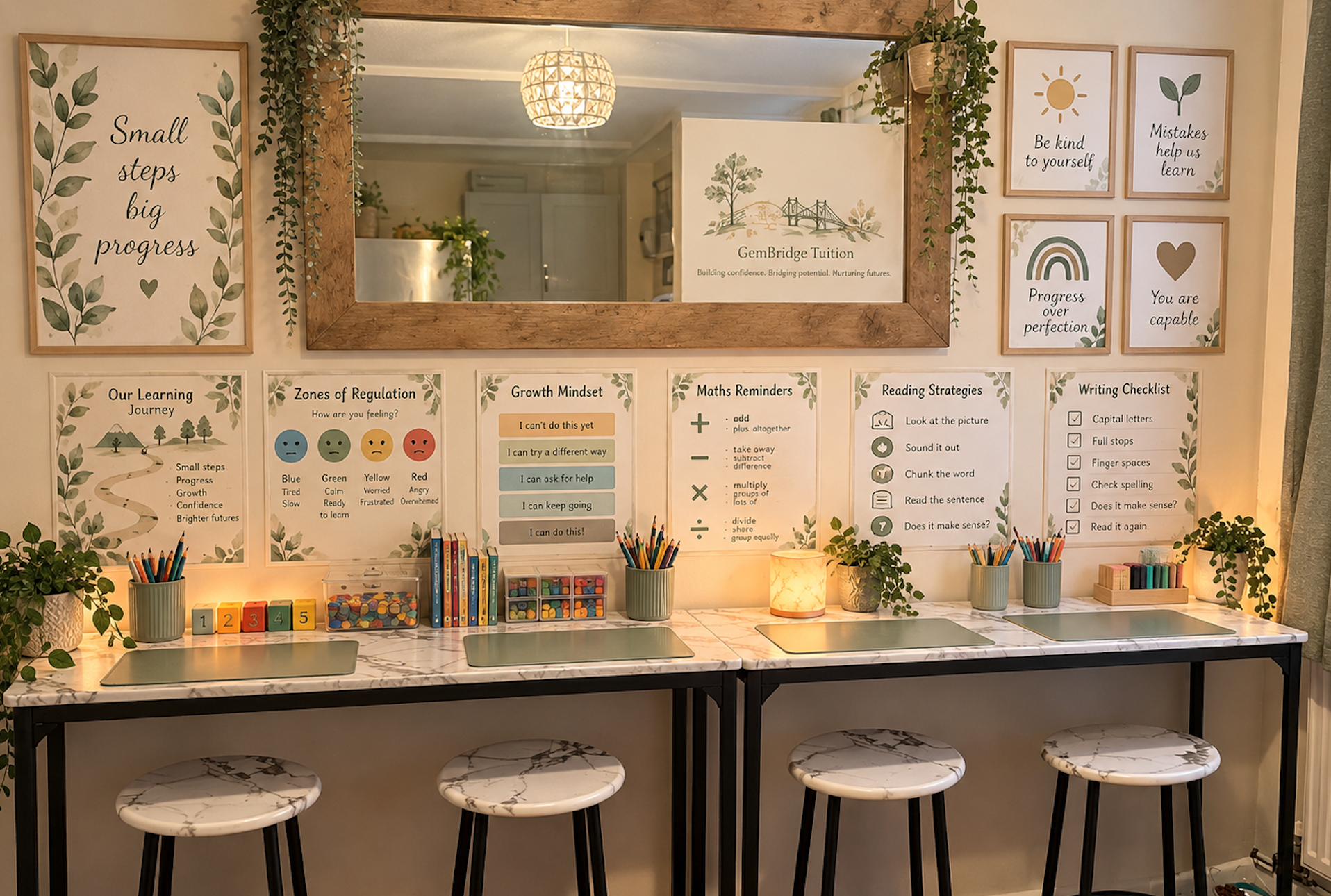
GemBridge small groups are deliberately kept to just 2–4 learners.
This keeps the calm, personalised feel of GemBridge tuition while giving children the opportunity to learn alongside peers.
Learners are carefully matched, considering factors such as learning level, needs, confidence and the type of support that will help the group work well together.
And small-group tuition doesn't mean replacing personalised learning with a generic group worksheet.
Each learner can still have individual learning priorities, appropriately adapted resources and different levels of support and challenge within the same session.
The benefits of a GemBridge small group
Children have opportunities to:
Build confidence and independence alongside peers
Learn that other children may find things tricky too
Practise explaining ideas, listening and learning collaboratively
Develop confidence contributing within a safe group
Experience some of the social benefits of a classroom without the demands of a large class
Work towards their own learning goals while being part of something shared
Gradually rely less on adult reassurance as their confidence grows
And because groups contain only 2–4 learners, there is still plenty of individual tutor attention.
Small-group tuition also offers families a more affordable way to access highly personalised tuition, without moving into a large group environment.
From 1:1 to small group – when your child is ready
For anxious learners in particular, moving from individual tuition into group learning doesn't need to happen suddenly.
A learner might begin with 1:1 sessions, establish a relationship with me and become comfortable with the routines and learning environment.
When appropriate, we can then explore whether a carefully matched small group could be their next step.
There's no fixed timetable for this.
For one child, that transition may happen quite quickly. Another may need considerably longer in 1:1 tuition. And some children may simply learn best individually.
The aim isn't to push children into groups. It's to give them opportunities to grow in confidence when they're ready.
What might we work on?
Both 1:1 and small-group tuition can support areas such as:
English & literacy
Reading • comprehension • spelling • writing • vocabulary • dyslexia-friendly literacy
Maths
Number fluency • place value • calculation • problem solving • mathematical confidence
Learning confidence
Re-engagement • independence • resilience • confidence communicating ideas • reducing anxiety around learning
Older learners
English and Maths catch-up • foundational skills • Functional Skills preparation • stage-not-age learning
Activities are adapted to the learners involved rather than following a fixed programme regardless of need.
SEND support without needing a label
GemBridge has particular experience supporting learners with dyslexia, dyscalculia, autism, ADHD, DLD, speech and language needs, SEMH and EBSA, but children do not need a diagnosis to access support.
Some children simply need more time, a different explanation, a quieter environment or someone to find the way of learning that works for them.
That's what GemBridge is about.
What's included?
Every GemBridge tuition session includes:
Individual planning and carefully selected or personalised resources
Learning adapted to individual starting points and needs
A written session record following each session, including the learning focus, progress made and next steps
Regular communication about learning and progress
Six-week block bookings also include a progress report at the end of the block, bringing together progress, areas for development and recommended next steps.
Small Group Tuition Prices
Online
£19 per learner, per 60-minute session
£105 per learner for a six-week block
Face-to-face
£20 per learner, per 60-minute session
£110 per learner for a six-week block
Groups are limited to 2–4 carefully matched learners.
Not sure whether 1:1 or small-group tuition is right?
That's absolutely fine.
We can talk about where your child is now, what they find difficult, what they enjoy and what you'd like tuition to help them achieve.
From there, I can recommend a starting point – whether that's the security of 1:1 tuition, a carefully matched small group, or beginning individually with the possibility of moving into a group as confidence grows.